A security operations center runs on telemetry, and every tool that produces it was bought to add visibility. A SIEM, an EDR, network monitoring, cloud security, identity controls, vulnerability scanners, email security, and threat feeds each see something the others do not, and a mature SOC needs several. The trouble starts when the stack grows without a plan for how the pieces work together. Tool sprawl is a collection of products with overlapping capabilities, disconnected workflows, inconsistent configurations, or features nobody uses. Past a point, adding tools stops improving visibility and starts obscuring it, and analysts spend the day managing the stack instead of investigating what it surfaces.
This article describes what sprawl is, how it degrades SOC work, and how a structured review turns a pile of tools back into a security operation. The aim is not a smaller stack, but one whose every part earns its place.
1. What sprawl is, and what it is not
Sprawl is not simply owning many products. Different tools provide different telemetry and detection, and a capable SOC may need all of them.In practice, tool sprawl becomes a problem when the stack is difficult to manage or lacks a coordinated operating model . Multiple tools perform similar functions. Separate dashboards raise overlapping alerts. Security data sits across platforms that do not talk to each other. Products are licensed but rarely opened. Information moves between systems by hand. Similar events carry different severities in different consoles, and analysts switch between consoles to work one investigation. The goal is not to cut tools because there are many, but to understand what each contributes, where capabilities overlap, how data moves, and whether the whole supports the SOC's work.
2. How sprawl degrades SOC work
The damage shows up in three connected ways. The first is fragmented visibility. A security event rarely stands alone, and an odd authentication becomes meaningful only next to an endpoint detection, a suspicious network flow, or an unexpected privilege change.When those signals remain separated across platforms, analysts may need to assemble the relevant context manually, which can lengthen investigations and make important relationships harder to identify. The second is alert fatigue. Each tool is another source of notifications, and when alerts are not tuned, correlated, or prioritized, the volume buries the signal, so low-value alerts absorb time, higher-priority events wait, and confidence erodes. The third is duplicated capability. Tools get bought for a specific need without reassessing what the environment already does, and over time several platforms cover the same ground, such as endpoint monitoring across EDR and XDR. Overlap is not automatically wasted, since tools can be complementary, but unexamined overlap usually is.
3. What a structured review examines
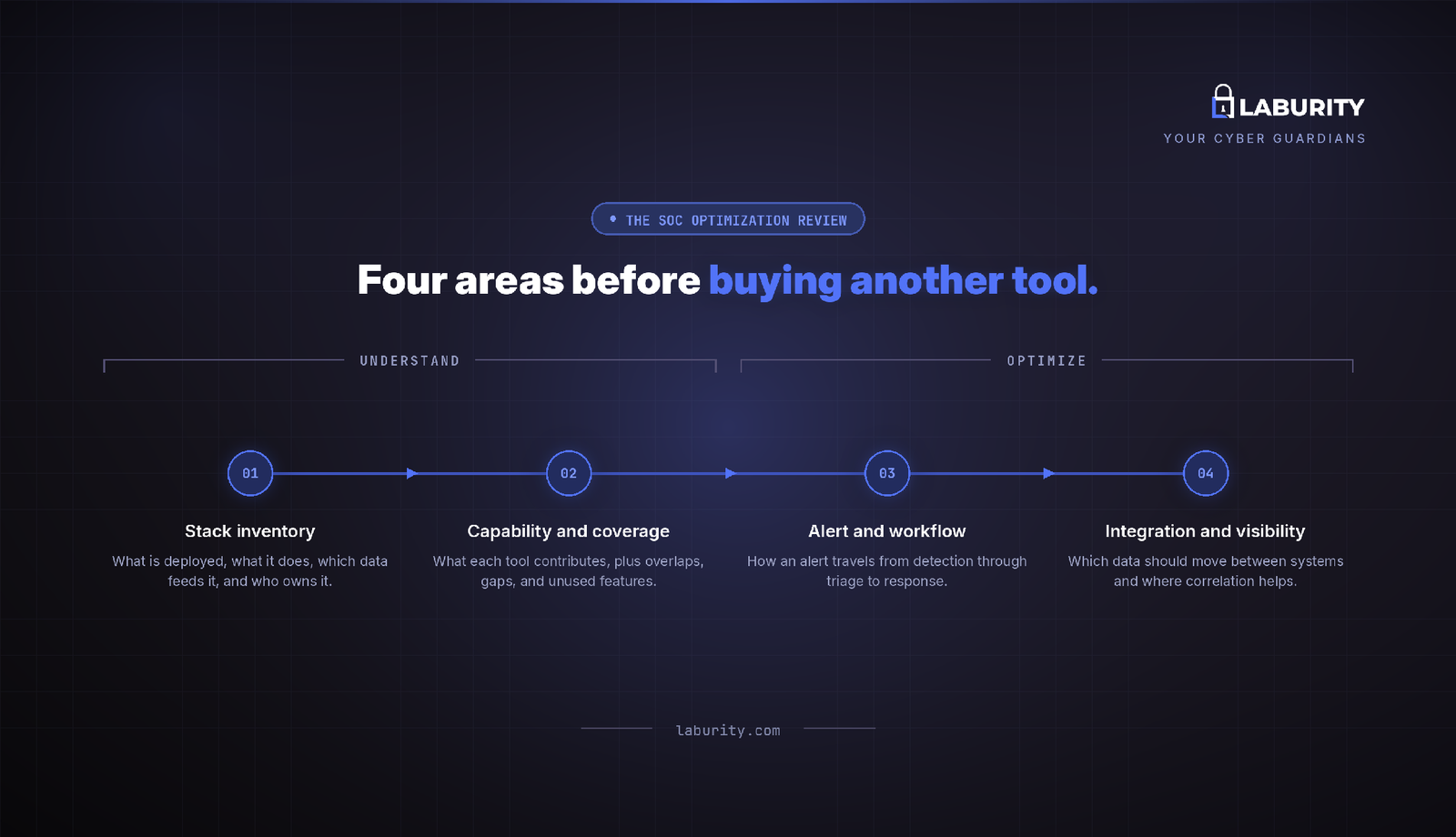
SOC optimization starts by understanding the environment, not adding to it, across four areas. It begins with a stack inventory, a clear view of what is deployed, what each platform does, which data feeds it, who owns it, how it integrates, and whether its licenses are used. It moves to a capability and coverage review, asking what each tool genuinely contributes and surfacing overlapping capabilities, missing coverage, underused features, redundant data, and the gaps where analysts fall back on manual work. It turns to alert and workflow optimization, mapping how an alert travels from detection through context, prioritization, investigation, escalation, and response, with clear ownership at each stage and prioritization driven by asset criticality, detection confidence, and business impact.NIST's guidance on cybersecurity risk prioritization similarly emphasizes considering potential impact on organizational objectives when determining risk priorities . Finally it addresses integration and visibility, deciding which data needs to move between systems and where correlation earns its keep, since connecting everything does not make an efficient SOC.
4. What changes when the review is done
Once the stack is understood, duplicated and underused pieces can be consolidated or retired, alerts tuned and correlated so the queue reflects real priority, and the integrations that matter are built while the ones that only add noise are left alone. The measure of success is where analyst time goes, to collect context in a sprawling stack, and to evaluate the events that matter in an optimized one.
A larger stack does not mean better security operations. When tools overlap, alerts are poorly prioritized, and data is scattered across disconnected platforms, analysts manage complexity instead of investigating threats. Stepping back to evaluate the whole operation, the tools, their capabilities, the alerts, the workflows that connect them, and the visibility analysts actually have, is what turns an expensive collection of products back into a functioning SOC.
Want to identify exposed manufacturing documents before they lead to further risk? Explore Darkwiser’s dark and deep web monitoring capabilities, scan your organization's exposure, or book a consultation with Laburity to discuss your security needs. Learn more at Laburity or contact [email protected]