A security vulnerability found after an application ships is a harder problem than one caught during development. The team has to reproduce the issue, confirm which versions are affected, build and test a fix, coordinate deployment, and often respond to customers. When the flaw sits in a widely used release, that work also competes with product priorities. This is why security belongs across the software development lifecycle and not only as a final gate before launch. NIST's Secure Software Development Framework recommends building secure practices into the SDLC to reduce vulnerabilities in released software and address their root causes.
For technology companies, the goal is not to remove every issue before release. It is to fix the weaknesses that matter as early as practical, when a change is cheaper and less disruptive. In this blog the focus is why these findings cost more after release, where secure code review and penetration testing each add value, and what a lifecycle security workflow looks like in practice.
1. Why post-release vulnerabilities cost more
Once software is in production, a security issue can reach far beyond the development team. It may touch deployed versions, production APIs and integrations, authentication and authorization logic, customer data, third-party components, and the cloud infrastructure behind the application. A development-stage finding usually enters the existing workflow and review process. A post-release finding often opens a separate remediation cycle that pulls in security, engineering, operations, and incident response at once.
The cost is never only the vulnerable line of code. One post-release issue can require investigation to map the affected component and attack path, development and testing of the fix, deployment across live environments, and a review to check for exploitation. The later a weakness surfaces, the more of the delivery process its remediation touches, and NIST notes that handling security earlier lowers the effort and cost of reaching the same objective.
2. Security belongs across the lifecycle
A final security test can catch important vulnerabilities, but it should not be the first moment security is considered. The SSDF organizes secure practices around preparing the organization, protecting software, producing well-secured software, and responding to vulnerabilities, so security applies at every stage from design through code review, testing, release, and retesting.
A secure code review examines source code directly for security flaws. OWASP highlights areas including input validation, authentication, authorization, session management, and cryptography. An application might authenticate a user correctly yet fail to enforce authorization when that user reaches another customer's resource, and a review can study that logic before the code ships.
3. Automated tools and manual review work together
Automated tools help teams find potential vulnerabilities during development, but they do not provide complete coverage of application security. Manual review adds context where scanners struggle, including business logic, application-specific authorization rules, and complex data flows. OWASP treats manual code review as complementary to SAST and DAST for these context-dependent issues. A practical approach combines automated detection, security-focused code review, and technical security testing, matched to the application's risk.
Code review examines the implementation. Penetration testing examines the application from an attacker's position, and it confirms whether a weakness is exploitable in the deployed environment and whether further attack paths exist. It never replaces secure development.
4. A practical workflow for secure delivery
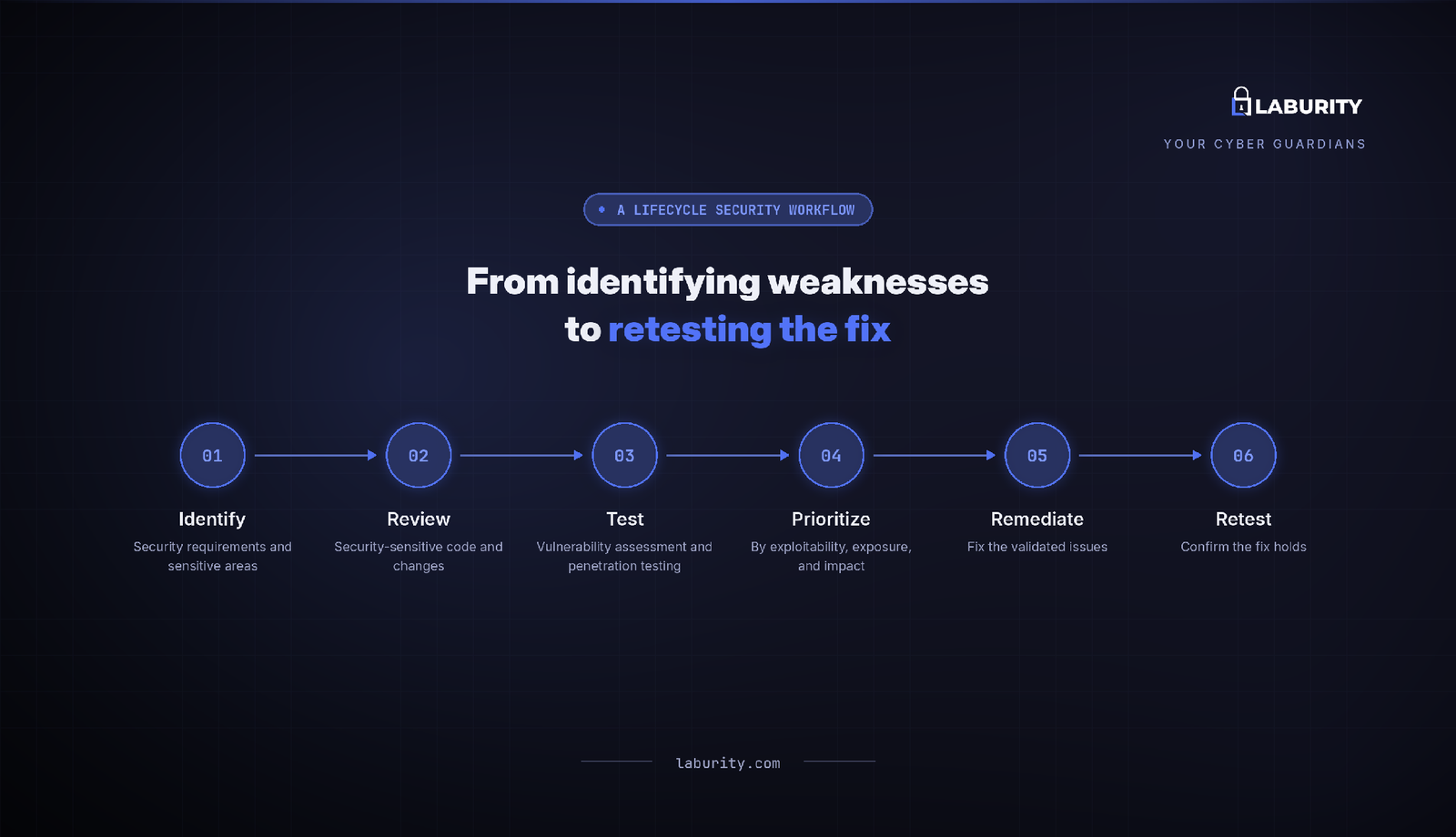
Security testing is most useful when it is tied to the lifecycle instead of run once. A practical workflow moves through six steps. Identify the security requirements and sensitive areas of the application. Review security-sensitive code and significant changes. Test through vulnerability assessment and penetration testing. Prioritize findings by exploitability, exposure, and impact. Remediate the validated issues. Retest to confirm the fix holds and the functionality stays secure. NIST likewise recommends assessing, prioritizing, and remediating by risk, then analyzing root causes to reduce recurrence.
Finding a vulnerability after release does not mean security was absent from the process, because weaknesses can survive careful testing. What matters is when they are found and how effectively the team can respond. Building code review, vulnerability assessment, penetration testing, and retesting into the lifecycle gives technology companies more chances to close weaknesses before release.
If you're looking to assess your organization's exposure to similar risks, Scan your organization's exposure, explore Laburity, or book a consultation.