Logistics operations depend on reliable access to the systems that coordinate warehouses, shipments, transportation, and deliveries. Warehouse employees use inventory platforms, drivers and dispatchers access transportation systems, contractors connect to specific services, and administrators manage critical infrastructure. Each role requires different permissions, but as employees change responsibilities, contractors leave, and operations expand across locations, access rights can become outdated or excessive.
These gaps can create security and operational risks. Employees may retain permissions they no longer need, shared accounts can make activities difficult to trace, and weak authentication can allow attackers to misuse stolen credentials. In logistics, where disrupted systems can delay shipments and interrupt supply chains, access weaknesses can affect both information security and business continuity.
An identity and access management (IAM) assessment combined with penetration testing helps organizations evaluate how access is assigned, managed, and protected. This article examines common access control weaknesses in logistics, where they can create the greatest risks, and how security testing can help identify and prioritize the necessary improvements.
1. Common Access Control Risks in Logistics
Access control weaknesses often develop as logistics operations grow and responsibilities change. Without regular reviews, permissions can become disconnected from employees' actual roles, while inconsistent authentication and account management leave gaps in protection.
Common issues include excessive privileges that remain after role changes, shared accounts that prevent reliable attribution of user activity, and weak authentication or inconsistent multi-factor authentication (MFA) across systems. Former employees and contractors may also retain active accounts after their access should have been revoked. Poorly controlled remote access can create additional entry points if an account is compromised.
These weaknesses do not necessarily mean that a security incident has occurred. However, they identify areas where an IAM assessment and authorized penetration testing can help determine whether access controls are configured appropriately, whether permissions exceed operational requirements, and whether weaknesses could allow unauthorized access to sensitive systems.
2. Where Access Risks Affect Logistics Operations
The impact of an access control weakness depends on the system involved and the permissions an account holds. In warehouse management systems, excessive privileges may allow users to modify inventory records or perform administrative actions beyond their responsibilities. In transportation management systems, weak authorization can expose shipment schedules, carrier information, and delivery records to unauthorized users.
Distributed logistics operations face additional challenges when access policies differ across sites or remote connections. If an account or device is compromised, inconsistent remote access controls can increase the risk of unauthorized access to business systems. Third-party and contractor accounts also require regular review to ensure that access remains limited to the systems and information necessary for their work.
Administrative accounts warrant particular attention because their elevated privileges can allow extensive changes to systems, configurations, and user permissions. If such an account is compromised, the potential impact may be significantly greater than that of a standard user account.
3. How an IAM Assessment and Penetration Testing Work Together
An identity and access management (IAM) assessment and penetration testing serve complementary purposes. An IAM assessment examines whether access controls are appropriately designed and managed, while penetration testing evaluates whether those controls can be bypassed or exploited within an agreed testing scope.
An IAM assessment reviews identity management, authentication, permissions, and access throughout the account lifecycle. This includes checking whether employee and contractor privileges align with their responsibilities, administrative access is appropriately restricted, multi-factor authentication (MFA) is enforced where required, and accounts are updated or disabled when people change roles or leave the organization. It also examines whether third-party access is justified, limited to necessary resources, and periodically reviewed.
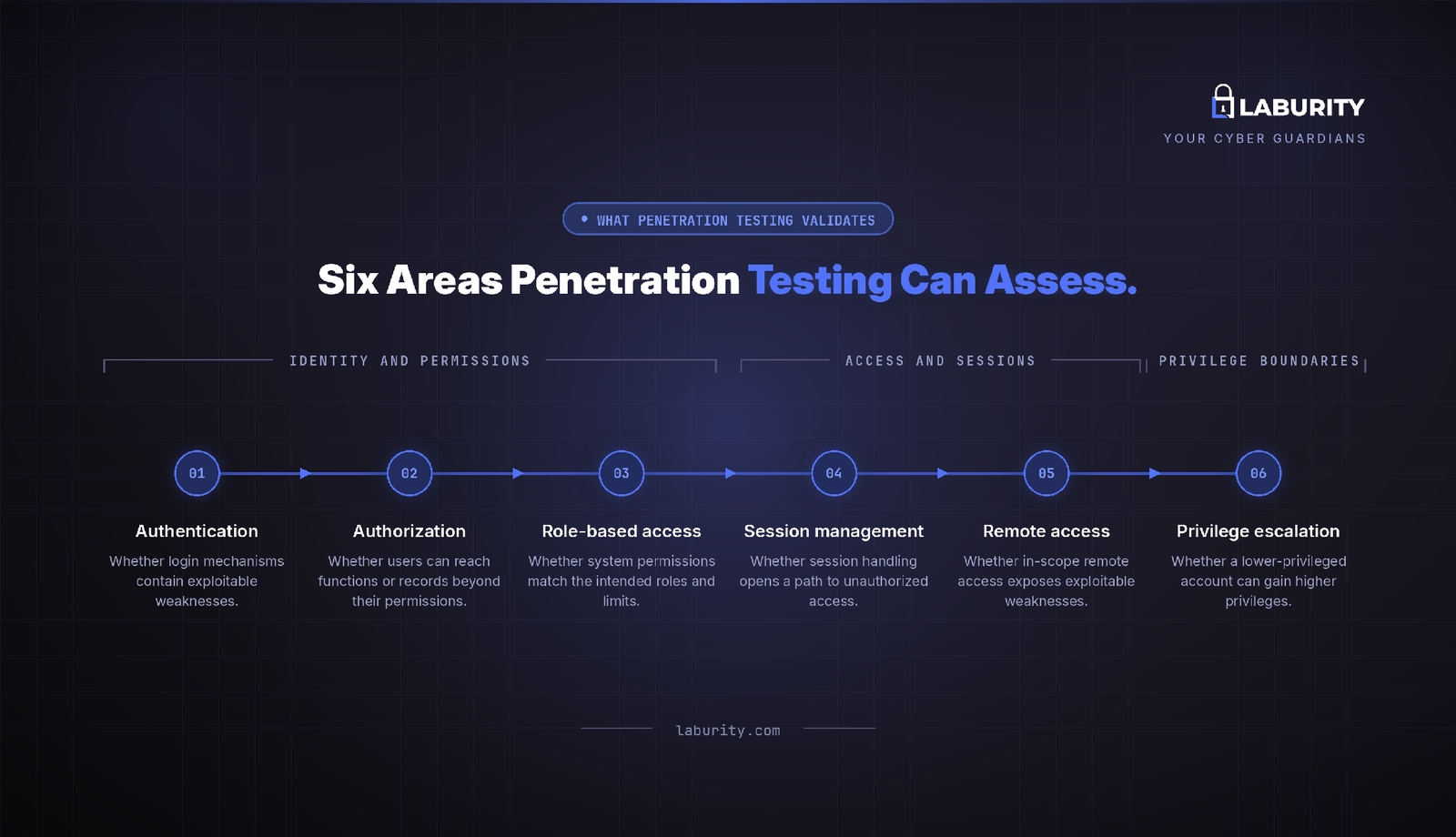
Penetration testing evaluates how these controls perform under realistic attack scenarios. Depending on the agreed scope, testing may examine authentication weaknesses, attempt to access records or functions beyond a user's permissions, assess whether privilege escalation is possible, and review session management and remote access security.
For logistics environments, testing must also account for operational continuity. Warehouse management and transportation systems may support active inventory handling, dispatch, and delivery operations. The testing scope, methods, timing, and safeguards should therefore be agreed in advance to minimize disruption while providing meaningful evidence of access control weaknesses.
Together, these activities help organizations identify gaps in access governance, verify whether technical controls work as intended, and prioritize remediation according to security risk and operational impact.
4. Security Measures to Address Access Control Weaknesses
The findings from an IAM assessment and penetration testing should translate into practical improvements to access controls across the logistics environment. Applying the principle of least privilege ensures that employees, contractors, and administrators have only the permissions necessary for their responsibilities. Enforcing multi-factor authentication (MFA), particularly for privileged accounts and remote access, adds protection against the misuse of stolen credentials.
Shared accounts should be replaced with individually assigned accounts to improve accountability and make user activity easier to trace. Access permissions should also be reviewed whenever employees change roles, contractors complete their assignments, or third-party requirements change. Accounts that are no longer needed should be disabled promptly.
Third-party access should be restricted to approved systems and reviewed regularly. Monitoring authentication events can help identify suspicious login attempts, unusual access patterns, and potential misuse of privileged accounts. Periodic access reviews and security testing can then verify that controls remain effective as systems, users, and operational requirements change.
Assigning clear ownership for these measures helps ensure that identified weaknesses are addressed, remediation is tracked, and access controls continue to support both security and operational continuity.
Identity and access controls play a central role in securing logistics operations, where warehouse management, transportation, and delivery systems depend on appropriate access for employees, contractors, and administrators. Excessive privileges, inconsistent authentication, outdated accounts, and poorly controlled remote access can expose these systems to unauthorized activity and operational disruption.
An IAM assessment helps identify weaknesses in access management and governance, while penetration testing evaluates whether technical vulnerabilities can be exploited within an agreed scope. Together, these activities help organizations understand their exposure, prioritize remediation, and strengthen access controls without losing sight of operational requirements.
Want to identify access control weaknesses in your environment? Book a consultation with Laburity, contact [email protected], or explore our services at Laburity.