A SaaS product runs on cloud infrastructure that is highly configurable, and that flexibility is where much of the real security risk lies. Under the shared responsibility model, the cloud provider secures the underlying infrastructure, while the organization is responsible for configuring identity, storage, networking, and services within its environment. The exact division of responsibility varies by cloud service and deployment model.
Even so, a single overly permissive setting can expose data that the application itself is designed to protect. A cloud misconfiguration is a resource, permission, or security control that does not provide the intended level of protection. OWASP includes improperly configured cloud permissions and exposed storage among examples of security misconfiguration because these issues can be easy to overlook, persist quietly, and remain accessible from outside the environment.
This blog explores the configuration areas that create the greatest exposure in a SaaS environment and explains how a cloud security assessment can turn identified findings into a prioritized hardening plan. These areas are closely connected, meaning a weakness in one can increase the potential impact of weaknesses elsewhere.
1. Key Areas of Cloud Exposure
The areas that warrant close review include identity and access management, where excessive permissions can accumulate; cloud storage, where overly broad access can expose sensitive data; security groups, where unnecessary inbound or outbound traffic can increase exposure; internet-facing cloud services; weak network segmentation; and administrative accounts with more privileges than their roles require.
These are not isolated configuration checks. Each setting needs to be evaluated against the organization's architecture, data, and business requirements. A configuration that is appropriate in one environment may introduce unnecessary risk in another.
2. Excessive IAM Permissions
Identity and access management determines which users, applications, and services can access specific resources, making it one of the most important areas for cloud security review. Excessive permissions arise when an account has more access than its role requires and often persist because removing access can feel riskier than leaving it in place.
NIST describes least privilege as limiting users and processes to the minimum access necessary to perform their tasks. An IAM review applies this principle by examining user and administrator roles, service and application identities, resource-level permissions, privileged accounts, unused access grants, and roles that provide broader access than intended. The key question is not whether a permission exists, but whether the identity actually needs it.
3. Exposed Cloud Storage
Cloud storage is an area where a single incorrect setting can directly lead to data exposure. Buckets and containers may hold application data, customer information, backups, and logs, while overly broad access controls can make them accessible beyond their intended scope.
An assessment reviews public access settings, bucket and container permissions, object-level controls, IAM policies affecting storage, shared access mechanisms, and temporary or signed URLs. The key question is not simply whether a resource is public or private, but who can access it, what they can do, and whether that level of access is necessary.
4. Networking, Services, and the Hardening Loop
Cloud networking controls determine how systems communicate with each other and with the outside world. As environments grow, security groups and firewall rules can become difficult to manage. Rules that were reasonable when created may remain in place long after the original need has disappeared, while overly broad rules can increase exposure.
A review examines inbound rules for publicly reachable ports, outbound rules where tighter egress controls may be appropriate, overlapping security groups, segmentation between sensitive and standard resources, and exposed administrative interfaces.
The same lack of review can lead to service sprawl. Unused services, outdated test environments, publicly accessible management interfaces, and default configurations can all expand the attack surface. An assessment identifies these exposures and evaluates whether each service is still required and appropriately secured.
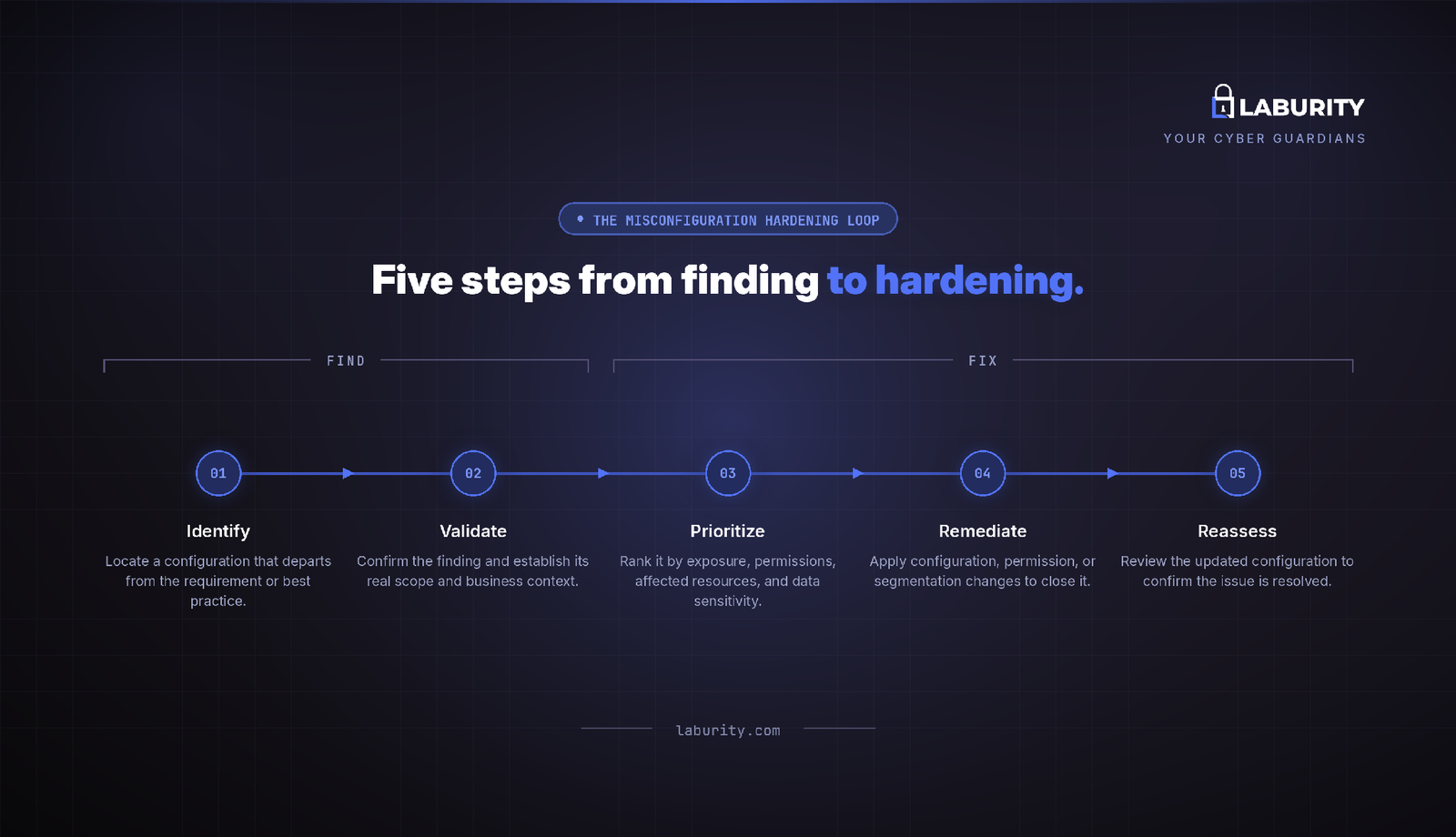
Finding a misconfiguration is only the first step. The value comes from the hardening loop that follows: identifying the deviation, validating the finding, prioritizing the risk, applying remediation, and reassessing the environment to confirm closure. This cycle turns a configuration observation into an actionable security finding and makes cloud security review more effective as an ongoing program.
A SaaS environment is more secure when its configuration is deliberate. Without regular review, configurations can gradually become broader than intended as systems, users, and services change. The useful question is not only whether the provider secures the underlying infrastructure, but whether the way the organization has configured identity, storage, networking, and services still matches its business needs, and where access or exposure has become broader than necessary.
If you're looking to assess your organization's exposure to similar risks, explore our services, or book a consultation.