JSON Web Tokens (JWTs) carry identity and authorization claims between clients and APIs, making them a common component of API authentication. However, a valid signature only confirms that the signed token has not been altered. It does not establish whether the API has correctly validated the signing algorithm, verification key, audience or associated permissions. JWT penetration testing examines how these checks are implemented and whether they withstand deliberately manipulated inputs. As the IETF explains in its JSON Web Token Best Current Practices, security weaknesses can arise from under-specified mechanisms, incomplete implementations and incorrect usage.
This article examines the key areas where JWT validation can fail and how those weaknesses may affect API authentication and access control. It covers algorithm selection, signing-key management, claim validation and header parameter handling, followed by the practical testing methods used to verify potential vulnerabilities. This gives engineering and security teams a clearer basis for reviewing their own JWT implementations and identifying where additional testing may be needed.
1. Why a Valid JWT Signature Is Not Enough
A compact JWT consists of three Base64URL-encoded components: a header, a claims payload and a signature. Anyone who obtains the token can decode its header and payload, meaning that signing protects the token's integrity but does not make its contents confidential.
Whether an API accepts a JWT depends on several validation checks, including the signing algorithm, the verification key and the claims presented in the token. These checks must be enforced correctly rather than relying on the presence of a valid signature alone. Understanding the structure of a JWT is therefore an important starting point when reviewing how an application handles token authentication.
2. How Algorithm and Key Handling Can Introduce Vulnerabilities
The alg header specifies the algorithm used to sign a JWT. RFC 8725 documents two significant implementation weaknesses. In one, libraries accepted tokens with alg: none, allowing the signature verification step to be bypassed. In another, an application expected an RS256 signature but accepted a token using HS256, treating the RSA public key as an HMAC secret. Because the public key is not confidential, this could allow an attacker to generate forged tokens.
A further example appears in the 2026 draft revision of the JWT Best Current Practices. It describes an implementation that attempted to block the none algorithm using a denylist but compared algorithm values case-insensitively, allowing a variation such as noNE to bypass the check. These examples demonstrate why applications should use an explicit allowlist of approved algorithms and bind each algorithm to the appropriate key type.
Weak signing secrets present a separate risk. When an API uses HS256 with a predictable or human-memorable secret, an attacker who obtains a signed token may attempt to recover the secret through offline guessing. If successful, the attacker could generate tokens with forged claims and impersonate other users, subject to the application's validation and authorization controls.
3. Claims and Header Values the API Must Validate
Even a correctly signed JWT may not be valid for the API receiving it. For example, a token issued for one service could be replayed against another if the receiving API does not verify its intended audience. Validating the iss claim against the trusted issuer and checking that aud identifies the receiving API help prevent this type of token substitution. Explicit token typing and mutually exclusive validation rules also reduce the risk of an ID token being accepted where an access token is required. In addition, validating exp and nbf helps ensure that tokens are accepted only within their intended validity period, limiting the window in which a stolen token can be used.
JWT header parameters also require careful handling because some can influence server-side operations. If a kid value is inserted into a database query without proper handling, it may introduce a SQL injection vulnerability. Similarly, an API that follows a jku or x5u URL supplied in a token without appropriate restrictions may be exposed to server-side request forgery (SSRF). These values should therefore be treated as untrusted input and validated before they influence key selection or external requests.
4. What JWT Penetration Testing Confirms in Practice
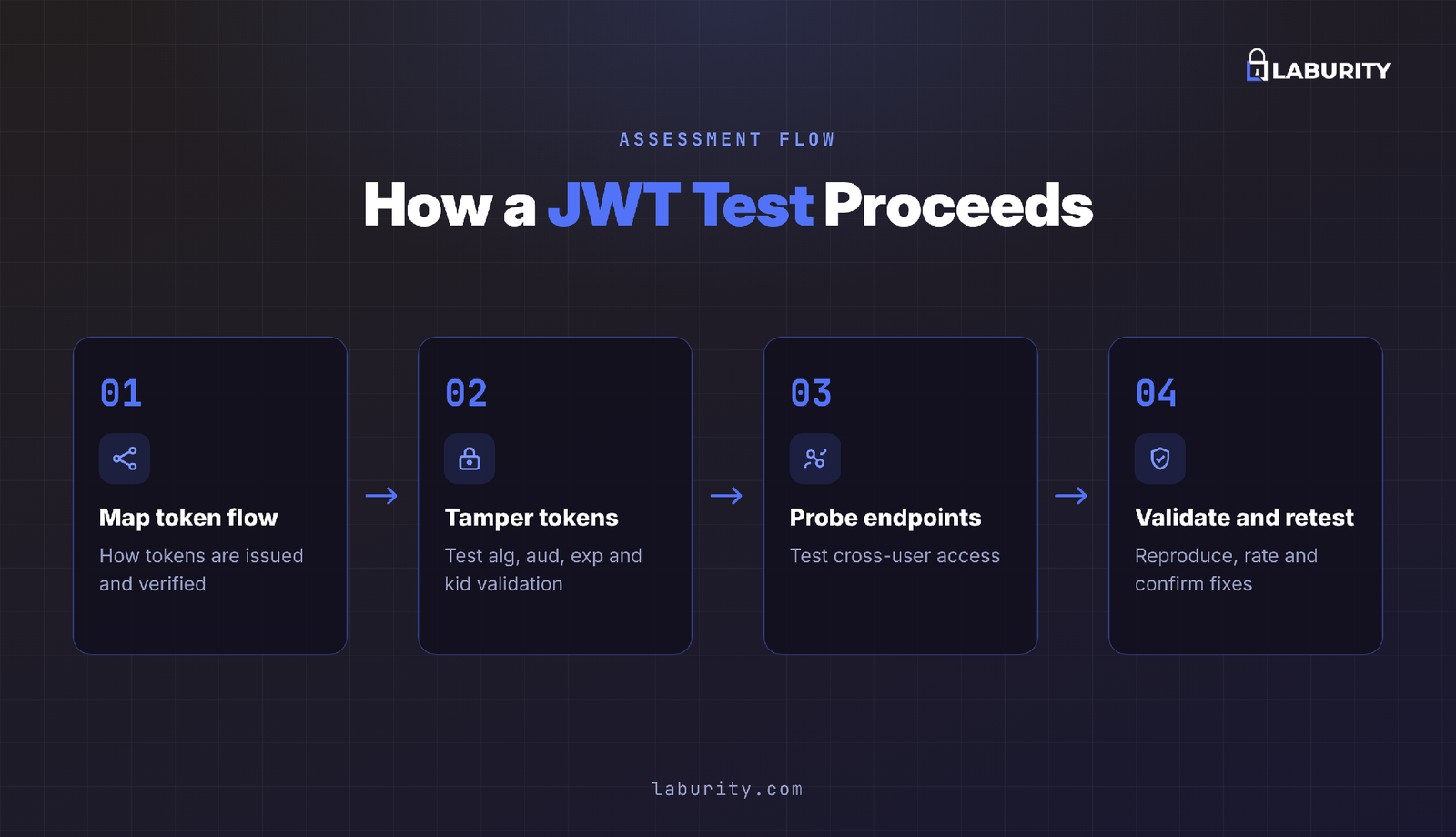
API penetration testing evaluates how JWT authentication and validation work across an application's protected endpoints. The assessment begins by examining how tokens are issued, signed and verified. Testers then submit modified tokens to determine whether the API correctly handles unexpected or manipulated values. These tests may include changing the signing algorithm, using a token intended for a different audience, submitting expired tokens and manipulating key identifiers.
The assessment also examines whether a valid token grants access only to the resources and actions permitted for its user. For example, a tester may attempt to use one account's token to access another user's data, identifying authorization weaknesses that signature validation alone cannot prevent. Each confirmed finding is documented with reproducible evidence, assessed according to its potential impact and retested after remediation.
Teams looking to understand the fundamentals before an assessment can begin with this introduction to securing APIs.
JWT security depends on how consistently an API validates tokens and enforces the permissions associated with them. Reviewing algorithm selection, signing keys, token claims and endpoint-level authorization helps identify weaknesses that could allow token forgery, misuse or unauthorized access.
If you're looking to assess your organization's exposure to similar risks, Scan your organization's exposure, explore Laburity, or book a consultation.