Attackers have always reused tools built for security testing, and agentic penetration testing frameworks are the newest example. Between late October and early November 2026, Google, Microsoft and CERT-EU each reported threat actors using ARTEX, an open-source agentic penetration testing framework powered by large language models, in real intrusions. Microsoft observed one agent move from searching public GitHub repositories for an exposed secret to accessing data in Azure Key Vault in just five minutes.
The underlying techniques are familiar. What has changed is how quickly an agent can combine exposed credentials, overprivileged workload identities and accessible cloud control planes to compromise an environment.
In this article, we examine how ARTEX reached threat actors, how its agents turned a GitHub leak into cloud access, and what incident logs reveal about their behavior. Drawing on the original reports, we explore which existing security weaknesses these tools exploit first and how organizations can identify them before attackers do.
1. How ARTEX Moved from Red Team Tool to Intrusion Kit
ARTEX accepts objectives written in plain language, breaks them into smaller goals and assigns tasks to specialized agent workers that execute security tools, according to CERT-EU's advisory on ARTEX.
Google describes ARTEX as a Go-based platform with six specialized sub-agents and a web console. The framework does not include its own language model, allowing operators to connect an LLM provider of their choice.
Its original author took the repository offline in October 2026 following reports of misuse. However, forks and rebranded versions continue to circulate. Google and Mandiant have identified ARTEX, PentAGI, CAIRN and other agentic offensive frameworks in incident response investigations. Reported users range from extortion groups to suspected espionage operators. CERT-EU has also reported activity targeting EU institutions and agencies that it assesses as highly likely to have involved ARTEX.
2. Five Minutes from a GitHub Search to Key Vault
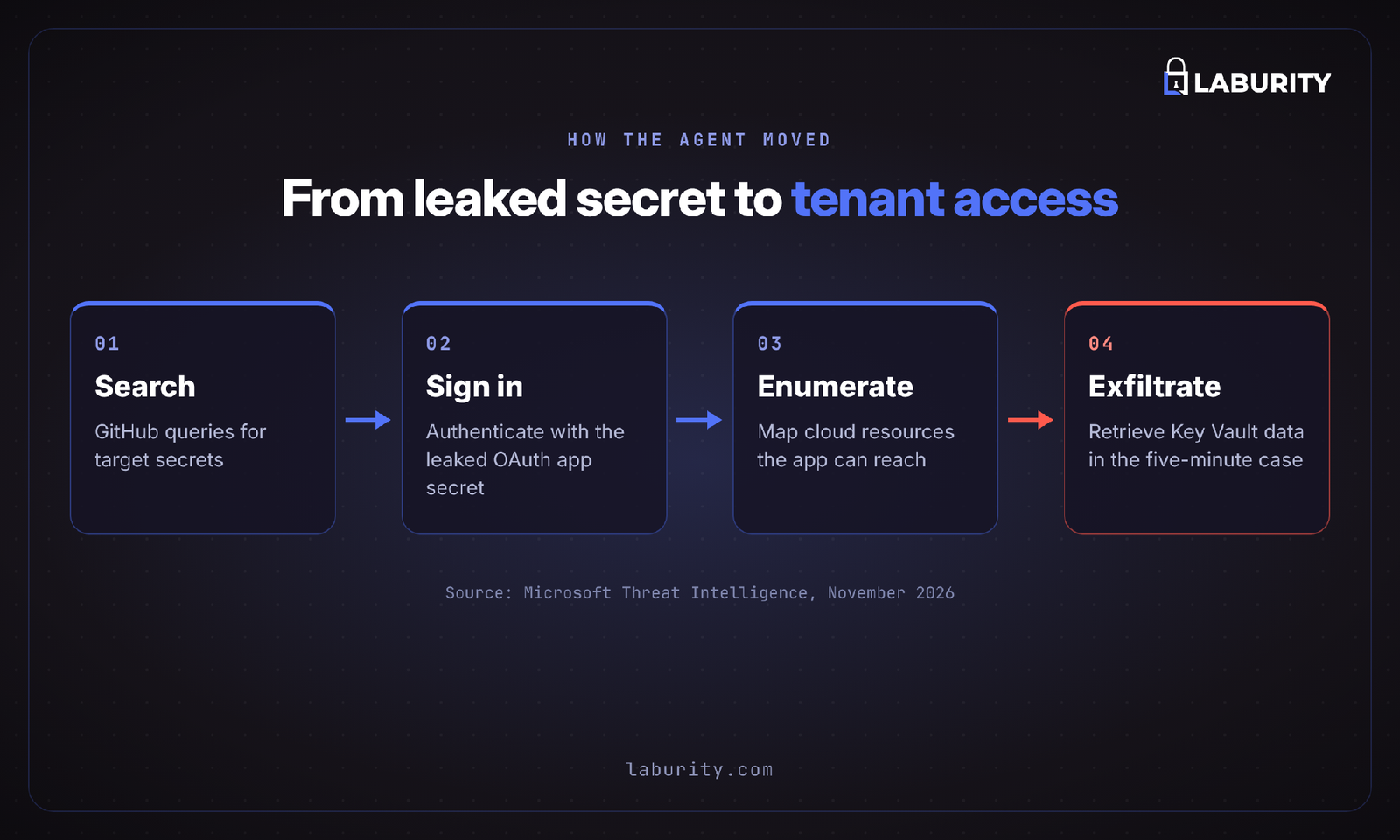
Microsoft's research on agentic secret hunting describes large volumes of GitHub searches combining target organization names with secret-related keywords and cloud or AI service terms.
When the agent discovered an exposed OAuth application secret, it authenticated as the associated service principal and gained access to resources permitted by that application's assigned permissions.
From there, the agent enumerated subscriptions and permissions, accessed secrets stored in Azure Key Vault, searched Azure DevOps and executed scripts on virtual machines through Azure Run Command.
It also corrected its own mistakes. When an API request failed because of an incorrect API version, the agent retried using a valid version approximately 28 seconds later and succeeded.
Microsoft emphasizes that deleting the exposed file does not invalidate the credential. Access remains possible until the secret is revoked or rotated. This makes credential rotation and identity permission reviews essential parts of incident response.
3. Machine-Speed Activity Leaves a Noisy Trail
Google and Mandiant's research illustrates how agentic frameworks can behave differently from human operators.
In one intrusion, ARTEX generated 27 events in 23 seconds while probing AWS permissions. In another, with valid credentials for a web application, it used an exposed SQL API to manipulate MySQL general query logging. It redirected database logs to a web-accessible location and attempted to inject JSP content through SQL queries, potentially creating webshells capable of enabling command execution.
That activity generated approximately 240 log events and repeated errors. Google suggests that some of this behavior may result from multiple sub-agents overwriting each other's actions.
Google also outlined a concerning progression toward increasingly autonomous attacks, warning that organizations should prepare for attacks requiring little human involvement and eventually stealthier autonomous operations. Its findings highlight an important challenge: detecting suspicious activity does not necessarily provide enough time to prevent an agent from completing its objective.
4. Testing the Attack Paths That Agents Chain Together
These incidents demonstrate why security assessments should examine how seemingly unrelated weaknesses interact.
A leaked client secret, excessive service principal permissions and an exposed management interface may each appear manageable in isolation. However, together they can create a direct path to sensitive cloud resources.
CERT-EU advises organizations to keep lower-severity findings within their remediation cycles because AI-driven tooling can combine minor misconfigurations into more serious attack paths.
Penetration testing covering cloud identities and exposed secrets helps identify whether these combinations create exploitable access paths. Adversary simulations that begin with a compromised credential can also reveal how far an attacker could progress through an organization's environment.
However, penetration testing provides a snapshot of security at the time of assessment. Continuous secret scanning, prompt credential rotation, short-lived workload identities, least-privilege access and monitoring of service principal activity help reduce exposure between assessments.
Agentic frameworks are not introducing entirely new attack techniques. They are changing how quickly those techniques can be combined and executed. An exposed secret can become an entry point to sensitive cloud resources, particularly when the associated application identity has excessive permissions.
For security teams, the priority is to understand which credentials remain exposed, what resources those identities can access, and whether existing controls can detect unusual activity before an attack progresses. Identifying and remediating these attack paths is essential to reducing the impact of automated intrusions.