Penetration testing, or pentesting, is a controlled security assessment that simulates a real cyberattack to identify and safely exploit weaknesses in an organization's systems. Unlike simply identifying vulnerabilities, it helps determine whether those weaknesses can actually be used to gain unauthorized access, move through the environment, or reach sensitive data.
By testing security from an attacker's perspective, organizations can uncover realistic attack paths, understand their level of risk, and fix weaknesses before they are exploited.
In this blog, we explore how penetration testing works, the different types of testing, and what organizations should do with the findings once an assessment is complete.
1. What a Penetration Test Proves That a Vulnerability Scan Cannot
Scanning and penetration testing are related security activities, but they answer different questions. Vulnerability scanning identifies known weaknesses such as outdated software, missing patches, exposed services, and insecure configurations. Penetration testing goes a step further by determining whether those weaknesses can actually be exploited and what an attacker could achieve.
Consider an outdated application. A vulnerability scanner may identify its version and flag a known vulnerability. A penetration tester investigates whether the affected component is reachable, whether the vulnerability is exploitable in the specific environment, and what level of access could be gained if exploitation succeeds.
The distinction becomes even more important when multiple weaknesses can be combined. A low-risk issue in one system may become significant when paired with a misconfigured permission, weak authentication control, or exposed service. An attacker can use these weaknesses together to create an attack path that an automated scan may not identify.
Manual testing helps uncover these relationships. Penetration testers assess how systems interact, validate whether security controls withstand realistic attack techniques, and determine whether individual weaknesses translate into meaningful business risk.
A vulnerability scan identifies potential weaknesses. Penetration testing shows what those weaknesses could actually allow an attacker to do.
2. How a Penetration Test Works
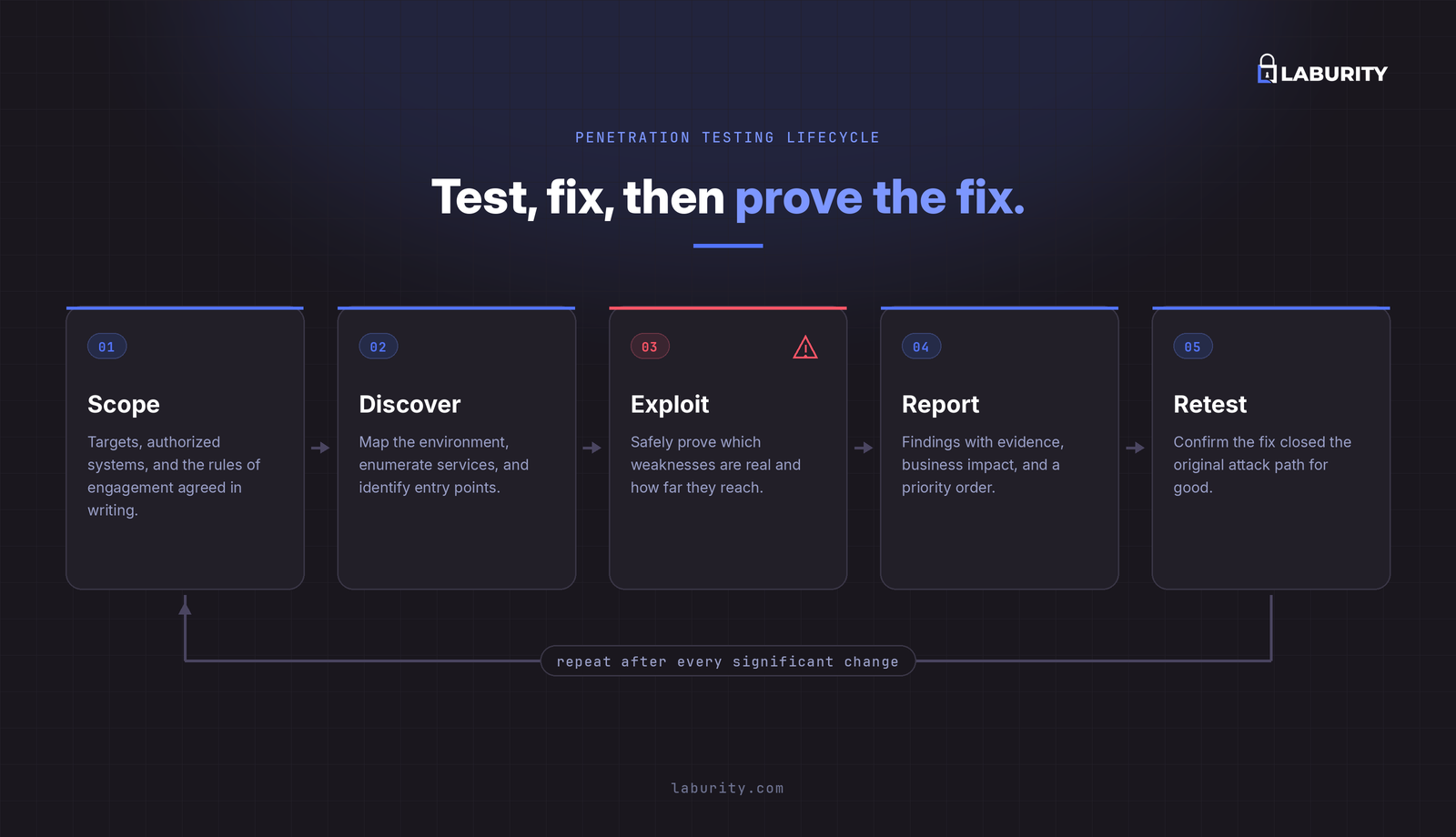
Most engagements follow a structured sequence. The exact approach depends on the target and the objectives, but the underlying process stays consistent across web, network, cloud, and mobile work.
- Planning and scoping. Agreeing which systems are in scope and how testing will be conducted.
- Information gathering. Mapping the environment and identifying potential entry points.
- Vulnerability identification. Finding weaknesses through automated tooling and manual analysis.
- Exploitation. Safely confirming which weaknesses are real and what they yield.
- Privilege escalation and lateral movement. Establishing how far initial access can be extended.
- Reporting. Documenting findings, evidence, impact, and remediation guidance.
- Retesting. Verifying that the fixes actually closed the original attack path.
2.1 Scoping and the rules of engagement
Testing begins before a single system is touched. The organization and the testing team define which applications, networks, APIs, cloud environments, and mobile applications are authorized targets, then agree the rules of engagement covering testing windows, permitted techniques, exclusions, communication procedures, and what happens if testing starts to affect production.
This step protects both sides. Without clear boundaries, an aggressive test can disrupt business operations or reach systems that were never meant to be in scope.
2.2 From information gathering to exploitation
Once the scope is defined, testers begin building an understanding of the target environment. An external assessment typically starts with identifying domains, IP addresses, DNS records, open ports, exposed services, and the technologies in use. An internal assessment, by contrast, may begin with the level of access available to a standard employee.
Vulnerability identification follows. Automated tools play an important role at this stage because they can assess large environments efficiently. Manual testing, however, is essential for identifying application logic flaws, access control weaknesses, authentication issues, and attack paths that emerge only when multiple conditions are combined. The objective is not to produce an extensive list of findings, but to establish which weaknesses are exploitable and how they connect to one another. The steps a penetration test follows provide a more detailed overview for organizations preparing to scope their first engagement.
Exploitation is where penetration testing moves beyond vulnerability identification. Testers safely attempt to exploit relevant weaknesses to validate their existence and determine their potential impact. For example, if an authorization flaw appears to allow one user to access another user's data, demonstrating that access within the agreed scope provides evidence of the vulnerability's real-world impact. An access control case study on a subscription platform illustrates how seemingly limited weaknesses can be combined to allow unauthorized modification of billing information and access to another user's payment history.
A successful compromise does not necessarily mark the end of testing. Testers may then assess whether the initial access can be expanded, including whether a standard user can obtain elevated privileges or whether a compromised system can provide a path to other systems. This reflects the way real-world intrusions often progress, with an initial foothold serving as a starting point for discovering credentials, additional systems, and higher levels of access.
2.3 Reporting and retesting
A penetration testing report should clearly document what was tested, what was identified, how each weakness was validated, its potential impact, and the recommended remediation. It should also help the organization prioritize its response, since a finding that provides direct access to sensitive systems warrants greater attention than one with limited practical impact.
The value of a report is not measured by the number of findings it contains, but by how clearly it communicates the organization's actual security risk and what needs to be done to reduce it.
Retesting completes the assessment by verifying that the reported vulnerabilities have been properly addressed and that the original attack paths no longer work. This final step is covered in more detail in Section 6.
3. The Main Types of Penetration Testing
Different environments call for different approaches, and most organizations end up combining several over time.
- Network penetration testing covers servers, network devices, and exposed services. External testing evaluates what is reachable from the internet, while internal testing examines what a malicious insider or compromised device could do from inside, including weaknesses in segmentation, authentication, and system hardening.
- Web application penetration testing covers websites and web-based applications, assessing authentication, authorization, session management, input validation, access controls, and business logic to establish whether an attacker can take over accounts, manipulate data, or bypass restrictions.
- API penetration testing examines authentication, authorization, object-level access controls, excessive data exposure, and input handling. An API that exposes sensitive functionality without enforcing correct permissions gives attackers a direct route to backend data.
- Mobile application penetration testing evaluates Android and iOS applications alongside the backends they talk to, covering authentication, local data storage, application logic, transport security, and API communication. Because mobile apps lean heavily on APIs, testing both together gives the fuller picture.
- Cloud penetration testing examines identity and access management, storage permissions, exposed services, network controls, and the relationships between cloud resources, to establish whether they can be accessed or abused in ways the design never intended.
4. Why Penetration Testing Matters to a Business
Testing gives organizations an opportunity to identify exploitable weaknesses before attackers can use them. Firewalls, endpoint protection, vulnerability scanners, and logging all play an important role in a security strategy, but none can guarantee that an attacker will not find a way through.
Penetration testing shifts the focus from simply asking whether a vulnerability exists to understanding the risk it creates:
- Can the vulnerability actually be exploited in this environment?
- What level of access could an attacker gain?
- Could that access be extended from one system to another?
- Could sensitive data be reached?
- Can privileges be escalated?
- Which security controls prevented or detected the attempt?
- Which weaknesses should be addressed first?
The answers provide a practical view of the organization's security exposure. Penetration testing can also uncover weaknesses that extend beyond individual technical vulnerabilities, including gaps in network segmentation, monitoring, incident detection, and internal security processes.
5. When a Business Should Run a Penetration Test
Penetration testing is most effective when treated as an ongoing security practice rather than a one-time exercise. Many organizations test at least annually, depending on their risk profile and regulatory obligations, but significant changes to the environment should also trigger a new assessment.
Common reasons to conduct penetration testing include:
- Launching a new web or mobile application
- Introducing or significantly changing a major API
- Migrating systems or applications to the cloud
- Redesigning network architecture or segmentation
- Deploying significant infrastructure changes
- Adding a major third-party integration
- Making substantial changes to authentication or access controls
- Recovering from a security incident
Each of these changes can introduce new attack paths that were not present during the previous assessment. Testing after significant changes helps determine whether new systems, configurations, or integrations have introduced weaknesses that could affect the organization's security posture.
Regulatory and compliance requirements may also dictate when testing must take place. Depending on the industry and applicable standards, organizations may be required to conduct penetration testing at regular intervals, after significant changes, or under both conditions.
6. What Happens After the Report Is Delivered
The report marks the beginning of remediation. Security and technology teams should review the findings, prioritize them according to actual risk, and assign clear ownership for remediation. The most urgent issues are typically those that provide a realistic path to sensitive systems, privileged access, or valuable data.
Remediation should address both the immediate vulnerability and, where possible, its underlying cause. If a penetration test identifies an authorization flaw in one application function, fixing that single endpoint may not be enough. The organization should determine whether the same implementation pattern exists elsewhere in the codebase and address the broader weakness where necessary.
Once the fixes are implemented, relevant findings should be retested under the same conditions used during the original assessment. This verifies that the vulnerability has been properly addressed and that the original attack path can no longer be reproduced.
Test → Discover → Remediate → Retest → Improve
This cycle is essential because security is not static. New applications, integrations, infrastructure, and configuration changes continuously reshape the attack surface. Regular testing and retesting help organizations identify those changes, address emerging weaknesses, and maintain a stronger security posture over time.
7. What Makes a Penetration Test Truly Valuable
A strong assessment shows how weaknesses affect the organization in practice, identifying realistic attack paths, demonstrating what an attacker could accomplish, explaining the business impact, and recommending clear fixes. The best engagements go further and connect those findings to remediation, explaining why a weakness happened, where else the same pattern may exist, and how to keep it from recurring, then staying involved until the fix is proven.
That is the distinction worth looking for when commissioning vulnerability assessment and penetration testing.
No security control can guarantee that an organization will never be attacked. What a business can do is understand where it is exposed and close those gaps first, and penetration testing is the controlled way to find out which exposures are real.
If you're looking to strengthen your cybersecurity posture or assess your organization's exposure to similar risks, we're here to help. Book a consultation or reach out to us. Learn more about our services at Laburity.