In most industries, the money and the vault are separate things. In digital assets, they are the same thing. A private key is the account, the balance, and the withdrawal authorization all at once. There is no bank to call, no chargeback, no fraud desk that can reverse a transaction after the fact. Once a key is exposed and the funds move on-chain, the loss is usually final, and the assets are often laundered within minutes.
That combination of high value, irreversibility, and pseudonymity is exactly why cryptocurrency holders, exchanges, and custody providers sit near the top of so many attacker target lists. Attackers also understand something the rest of the market sometimes forgets: the entire security model rests on a single fragile assumption, that every key was generated from genuinely unpredictable randomness. Break that one assumption and every downstream protection, from strong passwords to cold storage, becomes decoration. In the summer of 2026, that is precisely what happened.
What happened to Coldcard users
On July 30, 2026, Block’s Bitcoin engineering and security teams disclosed a flaw in the firmware of Coldcard, a widely used Bitcoin hardware wallet made by Coinkite. This was not a server breach. The weakness was in how the device produced randomness. Coldcard firmware was meant to draw entropy from the STM32 chip’s dedicated hardware random number generator, but a configuration error caused it to silently fall back to a deterministic software routine called Yasmarang, which seeded itself from predictable values such as the chip’s fixed hardware identifier and timing counters rather than true entropy.
The result was quietly catastrophic. Keys that looked random were reproducible from a small set of device states. As Block explained, an attacker could generate candidate keys, derive each wallet address, and stop the moment one matched an address on the public blockchain. For older Mk2 and Mk3 devices the practical search space collapsed to roughly a trillion possibilities, and Coinkite later confirmed that affected newer wallets held about 72 bits of entropy instead of the intended 128. That is well within reach of a motivated attacker, and because the flawed code had been present since 2021, keys on affected devices had been guessable for years.
The fallout for Coinkite and its customers
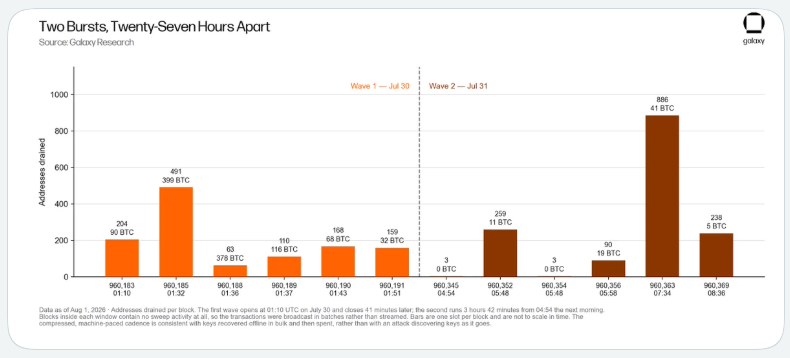
On-chain analysis by Galaxy Research traced the theft as it unfolded: attackers drained roughly 1,367 Bitcoin, about 88.6 million dollars, across three waves, with the first wave taking 1,083 Bitcoin from 1,196 addresses in just 41 minutes. Close to 4,585 addresses were affected in total. Every transaction used an identical, overpaid fee and left no change output, the signature of an automated tool run by someone who already held the keys.
For customers, the hardest part is what a fix cannot do. Coinkite released patched firmware, but updating it does not repair a seed already generated on vulnerable firmware. Anyone whose wallet was created on an affected device has to treat it as compromised, generate a fresh seed, and migrate their funds, effectively racing any attacker who has already derived the key. For Coinkite, the cost runs beyond engineering: in a market where trust is the entire product, a public flaw in the core promise that your keys are yours alone is expensive to repair, and the stolen Bitcoin is gone for good.
What the digital asset sector is up against
The Coldcard incident is a single vivid example of pressures the whole sector lives with every day:
- Losses are irreversible. There are no chargebacks and no central authority to unwind a theft, so a single key compromise is often total and permanent.
- The supply chain is the soft underbelly. Holders and firms rely on hardware, firmware, and libraries they did not build. A flaw in any one component can expose thousands of users at once, exactly as it did here, a pattern Laburity has traced before in its research into software supply chain attacks.
- Cryptographic bugs stay invisible until they are exploited. Weak randomness, reused values, and flawed key derivation produce output that looks perfectly normal and sails through routine testing.
- Public ledgers help attackers too. The same transparency that makes blockchains auditable hands attackers a free oracle to confirm a guessed key against real balances.
- Stolen assets move at machine speed. Mixers, cross-chain bridges, and instant swaps shrink the recovery window to minutes.
- Regulatory pressure keeps rising. Custody rules, licensing regimes, and breach notification duties mean a public incident invites scrutiny on top of the direct loss.
How Laburity reduces your exposure
No monitoring product would have generated a safe key for a Coldcard owner. What Laburity does is address the two moments that decide how much a flaw like this costs you: the moment it is written into your product, and the moment it starts being exploited in the wild.
For teams that build wallets, exchanges, or custody platforms, the Coldcard failure was a code and configuration error in how entropy was sourced. That is exactly the class of defect Laburity’s Secure Code Analysis and Vulnerability Assessment and Penetration Testing are built to surface. Reviewers look at how randomness is generated, how keys are derived, and how the software behaves when a preferred component is unavailable and it falls back to something weaker. Red Teaming goes a step further and tests whether keys and seeds can actually be reached under realistic attack conditions.
For everyone holding or safeguarding digital assets, Laburity’s Dark and Deep Web Monitoring watches the places where exposure shows up first: leaked seeds, private keys, and credentials, threat actors discussing your brand or infrastructure, and stolen assets or access being advertised for sale. The earlier you learn that something tied to you has surfaced, the more of that narrow recovery window you keep. If you want to understand why building this kind of protection early pays for itself, Laburity’s breakdown of the return on proactive security testing is a useful place to start.
The Laburity approach
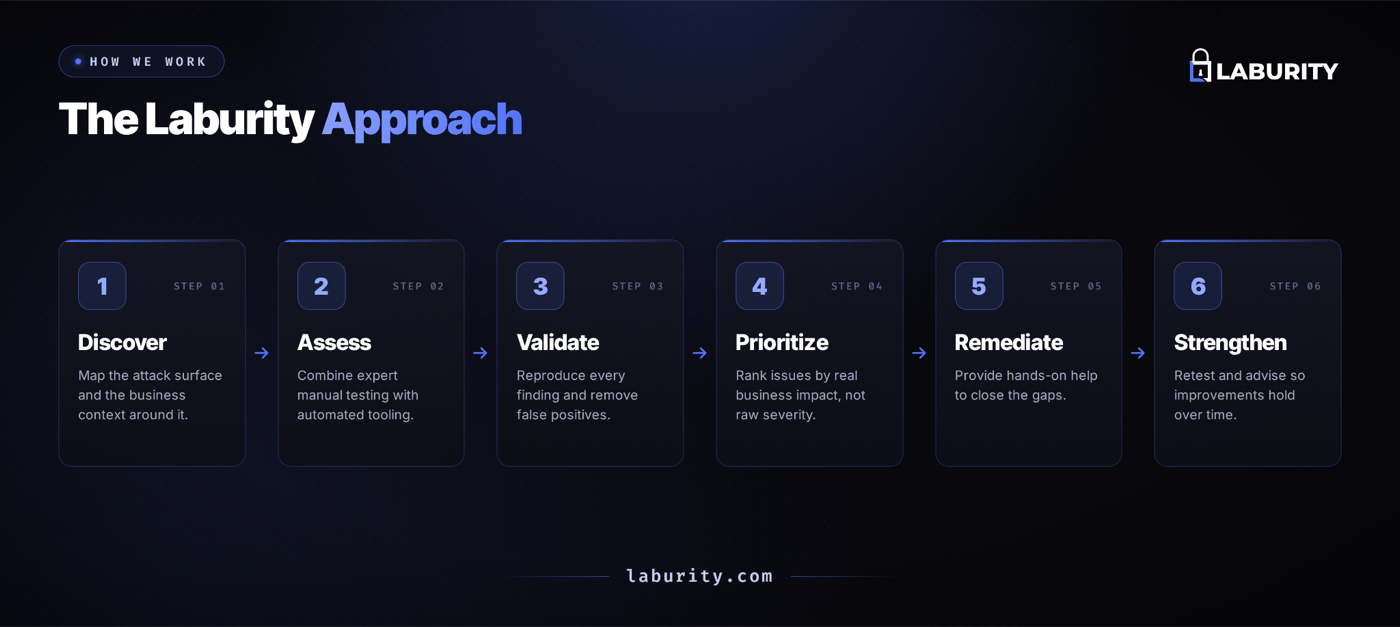
Laburity follows a six-step process on every engagement, built to find the real issues and make sure they stay fixed:
- Discover. Map the attack surface and the business context around it.
- Assess. Combine expert manual testing with automated tooling.
- Validate. Reproduce and confirm every finding to remove false positives.
- Prioritize. Rank issues by real business impact, not raw severity.
- Remediate. Provide hands-on help to close the gaps.
- Strengthen. Retest and advise so the improvement holds over time.
If you are building or safeguarding digital assets and want to know where your real exposure sits, Laburity can help. You can book a consultation, email the team at [email protected], or read more about the services at laburity.com.